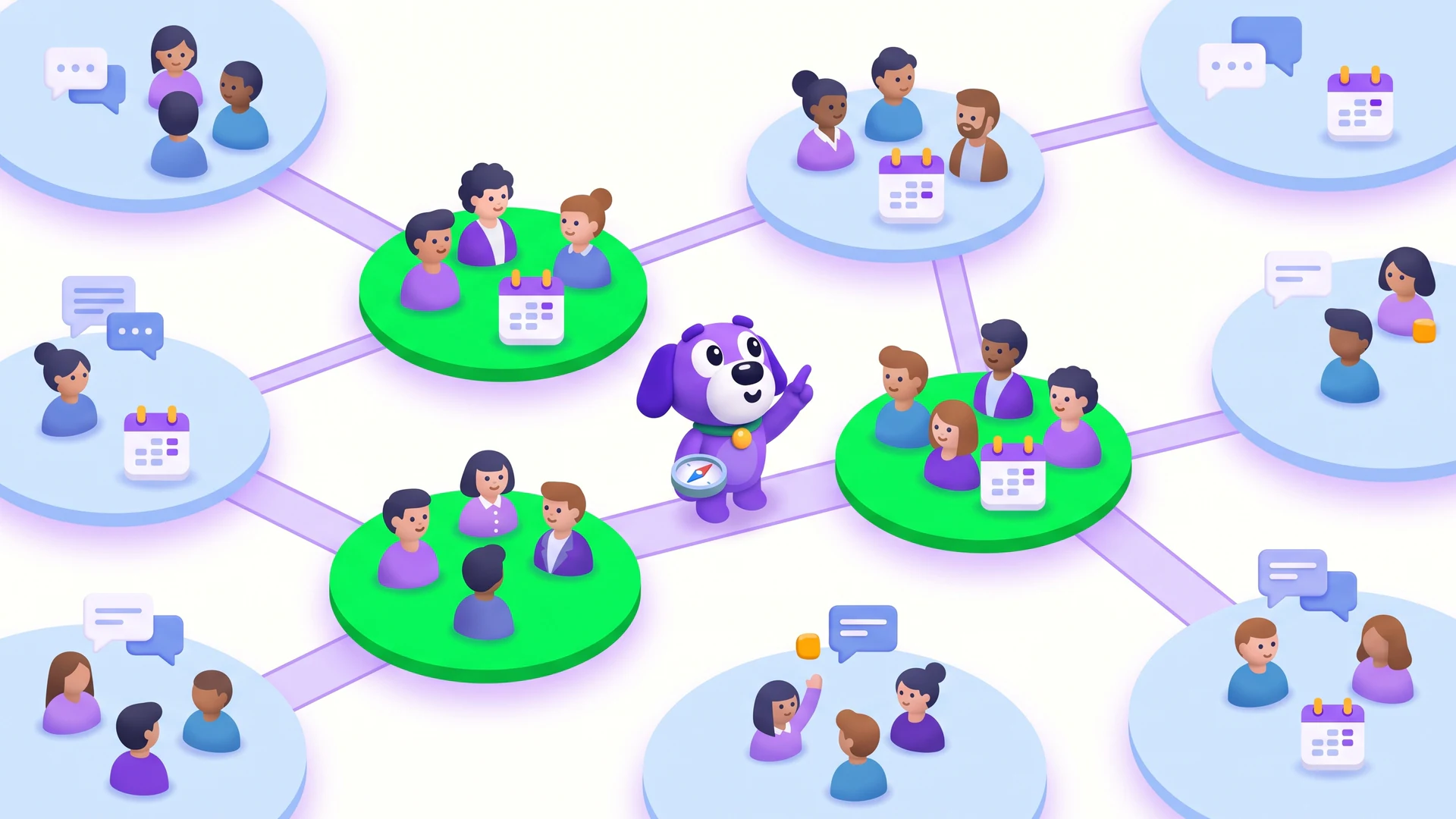
A community is neither a lead database nor a background for dropping links. It is a space with rules, a memory, and relationships built on trust. It becomes a good channel when you find recurring problems there, provide visible help, and let commercial conversations emerge from a legitimate context.
This guide is not a collection of abstract advice. It accompanies a Flairo mission located at the top of the page: answer a few questions, get a recommendation tailored to your context, and then copy the deliverable into your CRM or your next sales sprint. No account creation is required to test the experience.
The decision this guide should help you make#
You need to select two or three spaces where your expertise and your ICP overlap. The mission on this page uses Google grounding to search for current communities, their official pages, and their access conditions. Always check the date, activity, and rules before joining: groups evolve quickly.
Search by problem, role, and career stage#
The best queries do not just use your product category. Combine the user's role, the problem experienced, the industry, location, and experience level. A SaaS founder, a RevOps lead, and a recruitment agency manager do not necessarily frequent the same spaces, even if they might all buy a prospecting tool.
Qualify a community before investing time#
Check the official page, rules, recent events, and the density of conversations between members. Look for signs of life: recent questions, detailed answers, regular meetups, and identifiable moderation. Beware of directories that copy expired links. The mission provides sources; it does not replace human verification.
Apply the observe, help, then propose rule#
During the first week, note the vocabulary, problems, and preferred formats. Then answer specific questions with a method or a complete example. Do not slip your product into every comment. When a member explicitly asks for a solution or describes a problem you can solve, offer to continue in private with their consent.
Create assets the community will want to keep#
A calculator, an audit checklist, a signals database, or a detailed case study brings more value than a promotional article. Cite the resources that helped you and improve the asset based on feedback. This approach generates natural links because the resource deserves to be saved. Industry playbooks can serve as a starting point.
The actionable seven-day sprint#
The goal of a short sprint is not to automate everything. It serves to reduce uncertainty with a small set of observable actions. Keep the same target, offer, and definition of success for a week; otherwise, you will not know what accounts for the outcome.
- 01
Day 1 — describe your ICP, their immediate problem, and the vocabulary they use.
- 02
Day 2 — use the grounding mission to find ten spaces and open each official source.
- 03
Day 3 — eliminate inactive groups, those closed to sharing, or those dominated by self-promotion.
- 04
Day 4 — observe three communities and answer two questions helpfully without any commercial link.
- 05
Day 5 — publish a standalone resource that solves a small recurring problem.
- 06
Day 6 — review responses, objections, and silences. Separate targeting, timing, and messaging issues before modifying the campaign.
- 07
Day 7 — keep what generated a useful conversation, document what failed, and pick a single hypothesis to test the following week.
Measure without kidding yourself#
Track useful conversations, answers provided, feedback on your resources, qualified visits, and warm introductions. Avoid measuring solely the number of members or links dropped. The strongest signal is when someone else spontaneously reuses or recommends your work.
Activity metrics—volume sent, views, or connections—describe the work produced. Progress metrics—relevant replies, qualified conversations, held meetings, and opportunities—describe the value created. A good learning loop always connects both and keeps a sample of the messages actually sent.
How to use it with Flairo#
Start with the custom deliverable on this page. Then turn each hypothesis into a limited campaign: a segment, a signal, an angle, and a call to action. Flairo can centralize research, scoring, email and LinkedIn sequences, as well as response analysis. AI's role is not to disguise a generic message; it is to make a specific observation faster to leverage.
To build the complete system, continue with the buying signals prospecting guide, the ICP + timing scoring model, and the 30-day outbound playbook.