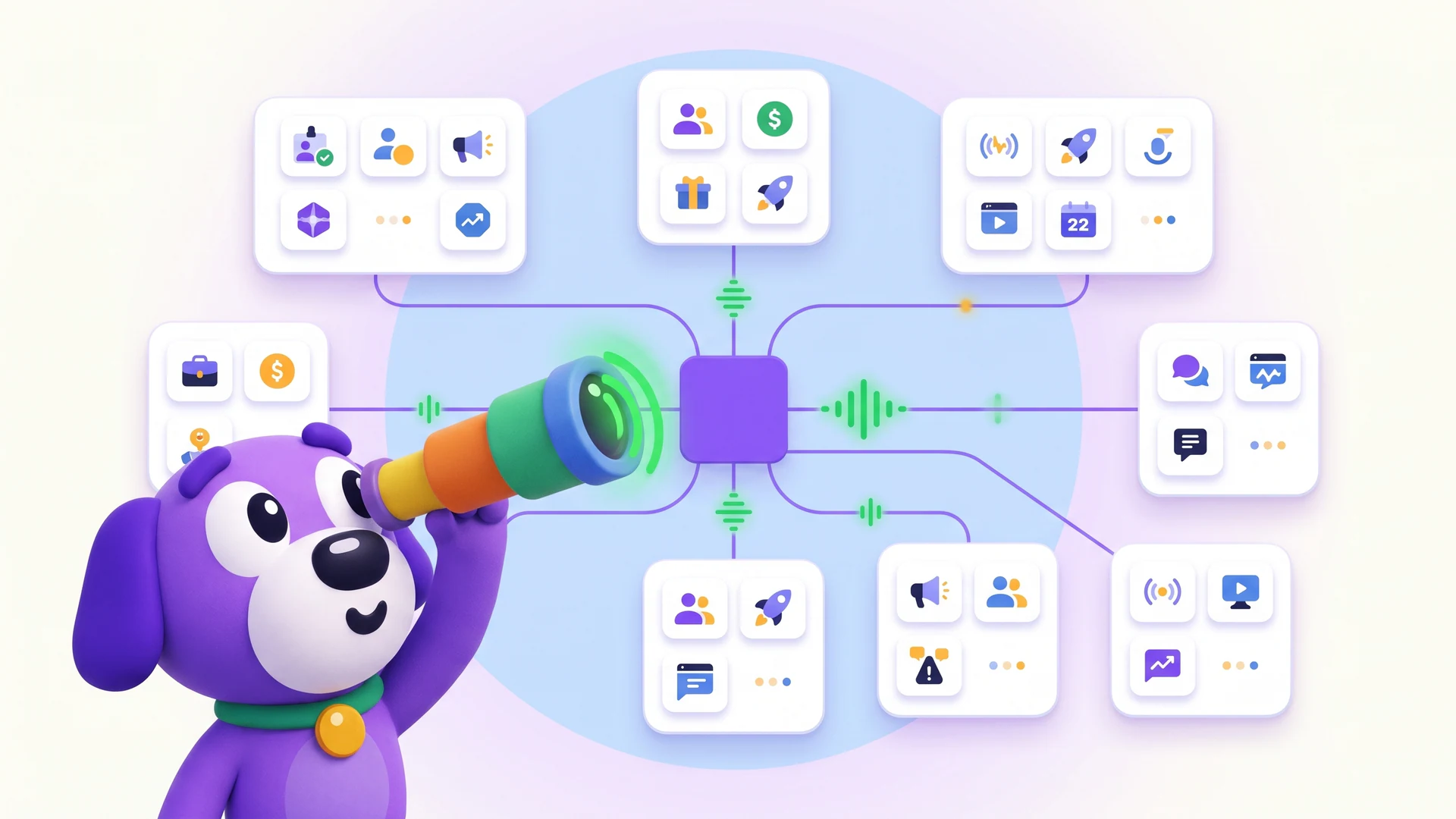
A list of signals isn't meant for piling up a hundred automations. It expands your observational vocabulary, then forces you to select a few events genuinely connected to the problem you solve. A signal becomes useful when it is detectable, fresh, interpretable, and specific enough to change an action.
This guide isn't a collection of abstract advice. It accompanies a Flairo mission located at the top of the page: answer a few questions, get a recommendation tailored to your context, then copy the deliverable into your CRM or next sales sprint. No account creation is required to test the experience.
The decision this guide should help you make#
Choose up to five signal categories for your initial monitoring: organization, hiring, technology, funding, regulation, market, content, product, or relationships. For each one, formulate the causal mechanism: what is changing, for whom, and for how long?
Organizational and human signals#
Arrival of an executive, creation of a team, office opening, reorganization, hiring wave, departure of a key role, promotion of a champion, or creation of a RevOps function: these events shift responsibilities and priorities. They don't prove budget, but they enable hypotheses about new coordination, speed, or control challenges.
Technology and product signals#
CRM migration, new tool addition, new integration, public incident, website redesign, feature launch, pricing change, documentation seeking contributors, or job postings mentioning a tech stack: every trace can indicate an ongoing initiative. Always verify its date and avoid assigning a problem without additional evidence.
Financial, commercial, and market signals#
Fundraising, profitability targets, acquisitions, new partnerships, RFPs, geographic expansion, visible price increases, or repositioning can alter urgency. The meaning depends on the sector: a funding round might trigger hiring at a SaaS company, but lead to complex post-acquisition integration in an industrial group.
Regulatory and operational signals#
New standards, compliance deadlines, threshold changes, audits, certifications, product recalls, supply chain tensions, or platform updates sometimes create a non-negotiable timeline. Rely on primary sources and keep an expiration date. For the difference between observation and intent, re-read intent data or buying signals.
The concrete seven-day sprint#
The goal of a short sprint isn't to automate everything. It serves to reduce uncertainty with a small number of observable actions. Keep the same target, the same offer, and the same definition of success for a week; otherwise you won't know what explains the result.
- 01
Day 1 — list twenty visible events in your sector without scoring them yet.
- 02
Day 2 — link each event to a consequence and an affected role.
- 03
Day 3 — eliminate signals that are impossible to date or too ambiguous.
- 04
Day 4 — assign fit, timing, confidence, and half-life to the top ten.
- 05
Day 5 — test five accounts per signal with a sentence that separates fact from hypothesis.
- 06
Day 6 — review responses, objections, and silences. Separate targeting, timing, and messaging issues before modifying the campaign.
- 07
Day 7 — keep what generated a useful conversation, document what failed, and choose a single hypothesis to test the following week.
Measuring without kidding yourself#
Measure signal precision: the share of accounts where the event is true, recent, and linked to a recognized problem. Add relevant response and conversion to conversation. A frequent but weakly causal signal can be less profitable than a rare and highly explanatory event.
Activity metrics—volume sent, views, or connections—describe the work produced. Progress metrics—relevant responses, qualified conversations, held meetings, and opportunities—describe the value created. A good learning loop always links both and retains a sample of the messages actually sent.
How to use it with Flairo#
Start with the personalized deliverable on this page. Then turn each hypothesis into a focused campaign: one segment, one signal, one angle, and one call to action. Flairo can centralize research, scoring, email and LinkedIn sequences, and response analysis. AI's role isn't to dress up a generic message; it's to make a specific observation faster to act on.
To build the complete system, continue with the buying signal prospecting guide, the ICP + timing scoring model, and the 30-day outbound playbook.