The recommended sequence#
For a first campaign, use four touchpoints over 12 to 15 days:
| Day | Channel | Goal |
|---|---|---|
| Day 0 | email or LinkedIn invitation | state the reason for outreach |
| Day 3 | other channel | build recognition without repeating |
| Day 7 | provide proof or a resource | |
| Day 12 | most natural channel | close the loop |
This framework is a starting point, not a universal truth. An explicit request deserves a same-day response; a strategic account can justify more research and a manual step.
Multichannel doesn't mean repetition#
Copying the same text into an email and a LinkedIn message doubles the annoyance, not the relevance.
| Channel | Role in the sequence | Format |
|---|---|---|
| explain a hypothesis and proof | 50 to 100 words | |
| LinkedIn invitation | make outreach recognizable | one sentence, no mini-pitch |
| LinkedIn message | short conversation tied to profile or signal | 30 to 60 words |
| Useful content | allow the prospect to move forward without a meeting | checklist, benchmark, or diagnostic |
lemlist recommends spacing out initial touches and using conditional branches. The key logic isn't the exact number of days: each new step must respect the observed behavior.
Step 1 — Choose the best initial channel#
Start with email when:
the business address is verified;
the topic requires a few sentences;
the prospect is barely active on LinkedIn;
the social proof is external to a social post.
Start with LinkedIn when:
the signal comes from a post by the prospect;
a mutual connection or shared community exists;
the email address is not reliable enough;
the message can be understood in a single sentence.
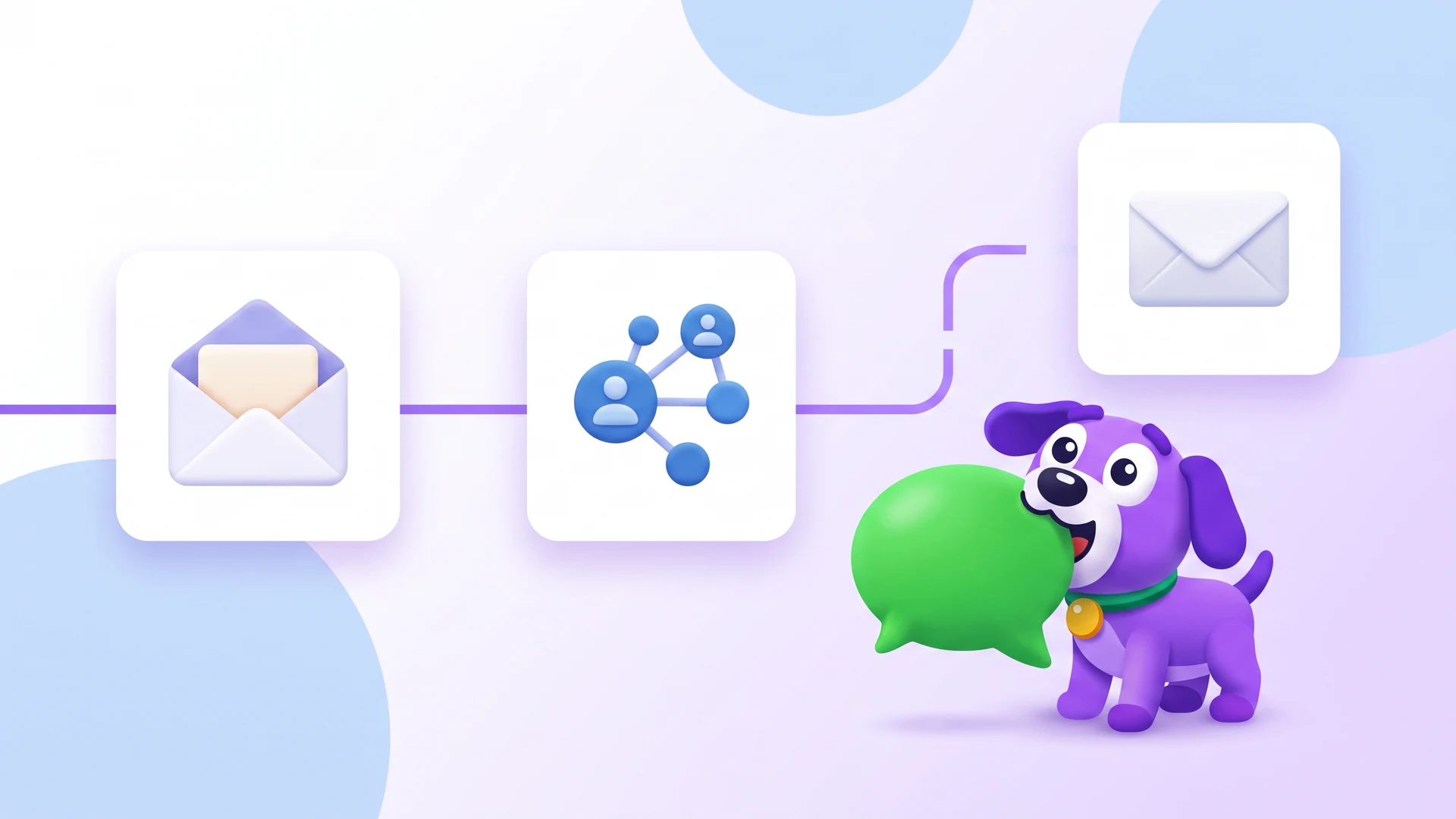
Flairo lets you configure email, LinkedIn invitations, and LinkedIn messages in the same automation, then stop scheduled actions when a response comes in.
Step 2 — Write the first message#
The first message follows this structure:
“Observed fact → possible challenge → relevance → simple question
Email example:
“Subject: Belgium sales team
Hi Mehdi, I saw your four sales job listings for the expansion into Belgium. During this phase, targeting and follow-ups often get fragmented across new hires. Flairo helps small B2B teams identify the right accounts and orchestrate their outreach from a single context. Is this an initiative for you this quarter?
Avoid generic compliments, company bios, and calendar links in the very first line.
Step 3 — Switch angles in follow-ups#
A good follow-up doesn't say "did you see my message?". It adds something new:
Follow-up with proof
“Adding a quick practical point: in the campaigns we structure, we separate fit from signal before launching a sequence. I can send you our 100-point scorecard if helpful.
Follow-up highlighting risk
“Another perspective: the risk isn't just volume, but that every sales rep picks accounts based on different criteria. Is this already standardized on your end?
Breakup follow-up
“I'm closing the loop after this message. If structuring your outbound sales becomes a priority later, I'd be happy to share the playbook. All the best with the Belgian expansion.
Stop rules#
A healthy sequence stops immediately if:
the prospect replies on any channel;
an unsubscribe or objection is received;
the email address hard bounces;
the contact leaves the company;
the account becomes a customer or partner;
targeting is invalidated;
the lead is withdrawn from the sequence.
Centralize email and LinkedIn in a single inbox to prevent an email follow-up from going out after a social media reply.
Operational limits#
Don't build your strategy around a number presented as a universal "safe limit." Providers and platforms apply their own rules, which vary by account and evolve over time.
In Flairo:
quotas are shared per connected account;
the prospect's working hours define sending windows;
unverified addresses can be kept out of sequences;
future actions are canceled upon reply or objection;
Copilot or Autopilot mode determines the validation level.
Testing before launch#
Preview at least ten prospects and check:
- 01
is the signal accurate and dated?
- 02
is the primary channel available?
- 03
does the message avoid unverified claims?
- 04
does each follow-up offer a new angle?
- 05
can the question receive a short answer?
- 06
are stop rules configured?
- 07
is someone monitoring replies?
Measuring the sequence#
Track by branch:
prospects contacted;
bounces;
total replies;
positive replies;
objections;
confirmed interest;
average time to first reply.
Don't conclude that "LinkedIn works better" if the LinkedIn accounts were also your warmest accounts. Compare similar segments.
The simple version in Flairo#
In Automation, start with an invitation or an email, a delay, the second channel, and a short follow-up. Preview, then activate in Copilot mode. Once targeting and messaging stabilize, switch to Autopilot.
To protect compliance and domain reputation, also read B2B cold email: GDPR and deliverability.