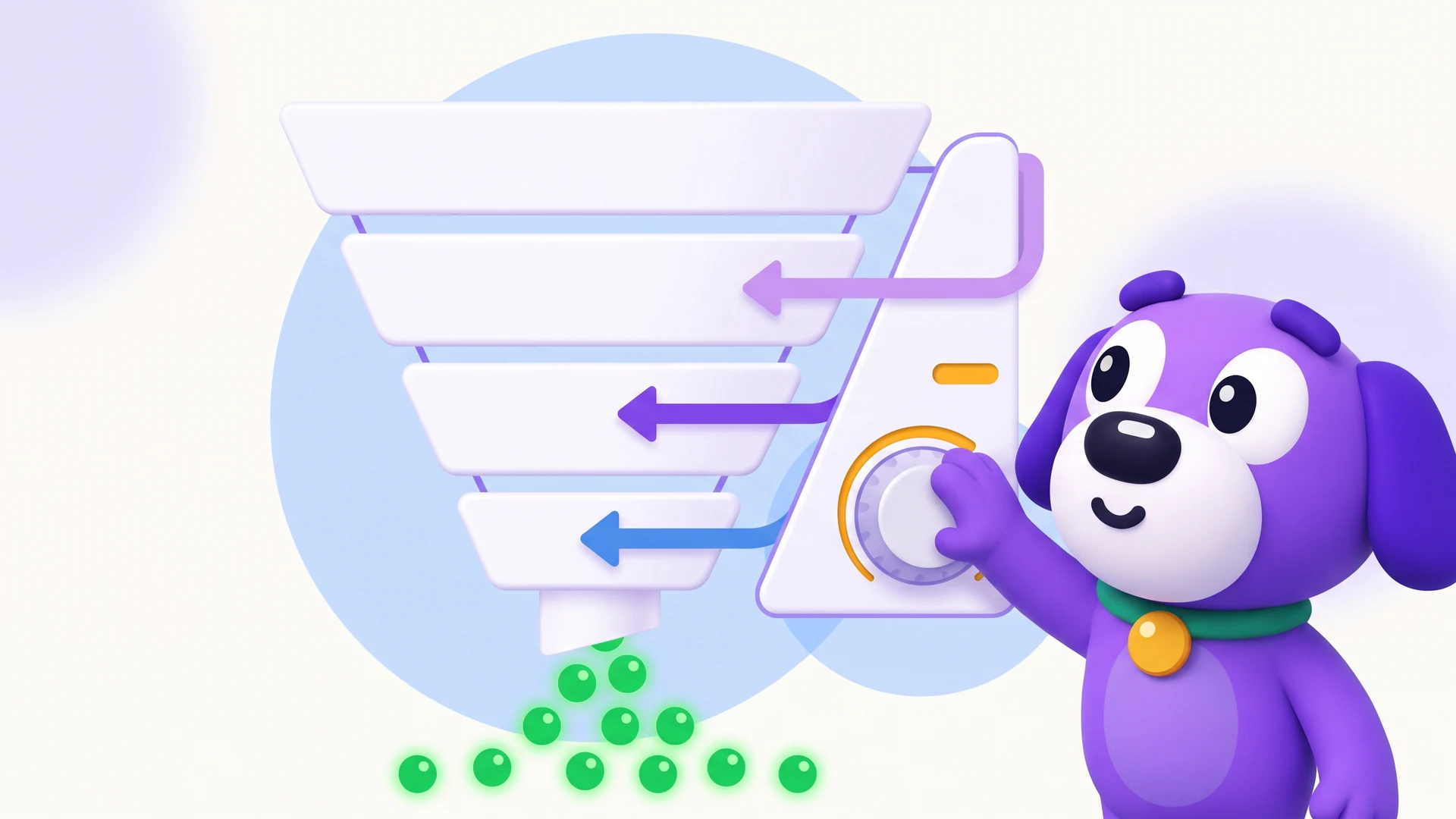
Saying “we need to send a thousand emails” is not a plan. The required volume depends on multiple conversion steps: reachable account, delivered message, relevant reply, completed meeting, qualified opportunity, and closed deal. The calculation is useful when it lays out every assumption and shows which step is truly limiting growth.
This guide is not a collection of abstract advice. It accompanies a Flairo mission located at the top of the page: answer a few questions, get a recommendation tailored to your context, then copy the deliverable into your CRM or your next sales sprint. No account creation is needed to try out the experience.
The decision this guide should help you make#
Decide whether your goal is compatible with your market size, research capacity, available meeting capacity, and sales cycle. The interactive mission calculates multiple scenarios based on your rates; it should not turn a fragile estimate into a certainty.
Working backward from customers#
To get ten customers with a 25% win rate, you need forty qualified opportunities. Continue working back through each step using your own conversion rates: completed meetings, qualified responses, delivered contacts, and actionable accounts. Use ranges rather than a single figure when data is scarce.
Distinguishing contacts from accounts#
A single company may have multiple points of contact, but reaching out to all of them at once increases the risk of a bad buyer experience. Model an average number of contacts per account and set up orchestration rules. The real constraint is often the number of accounts fitting the segment, not the number of email addresses available from a vendor.
Factoring in human capacity#
Every reply requires qualification, research, and follow-up. Every meeting consumes prep time and debriefing. Calculate your available weekly time and limit campaigns to what the team can handle properly. AI can speed up preparation; it should not generate a volume of abandoned conversations.
Testing the elasticity of your assumptions#
Vary deliverability, relevant response rate, show rate, and win rate independently. The most sensitive lever often deserves deeper analysis. If doubling the volume exceeds your addressable market, the plan must improve the value proposition, targeting, or channel instead. Then compare this capacity against the journey to your first 10 B2B customers.
The actionable seven-day sprint#
The goal of a short sprint is not to automate everything. It serves to reduce uncertainty with a small set of observable actions. Keep the same target, the same offer, and the same definition of success for a week; otherwise you won't know what caused the result.
- 01
Day 1 — gather your actual rates and note the timeframe and sample size.
- 02
Day 2 — calculate low, base, and high scenarios without mixing segments.
- 03
Day 3 — convert volumes into hours of research, sending, and follow-up.
- 04
Day 4 — identify the step that impacts the final outcome the most.
- 05
Day 5 — launch a small batch to replace an assumption with observed data.
- 06
Day 6 — review replies, objections, and silences. Separate issues with targeting, timing, and messaging before modifying the campaign.
- 07
Day 7 — keep what generated a useful conversation, document what failed, and pick a single assumption to test the following week.
Measuring without fooling yourself#
Track each step with its exact denominator. An auto-reply is not a relevant reply; a booked meeting is not always a completed meeting; an opportunity is not a customer. Display ranges and sample sizes alongside every rate.
Activity metrics—volume sent, views, or connections—describe the work produced. Progression metrics—relevant replies, qualified conversations, completed meetings, and opportunities—describe the value created. A good feedback loop always connects both and keeps a sample of the actual messages sent.
How to use it with Flairo#
Start with the custom deliverable on this page. Then turn each assumption into a scoped campaign: one segment, one signal, one angle, and one call to action. Flairo can centralize research, scoring, email and LinkedIn sequences, and reply analysis. The role of AI is not to disguise a generic message; it is to make a specific observation faster to act on.
To build the complete system, continue with the signal-based prospecting guide, the ICP + timing scoring model, and the 30-day outbound playbook.